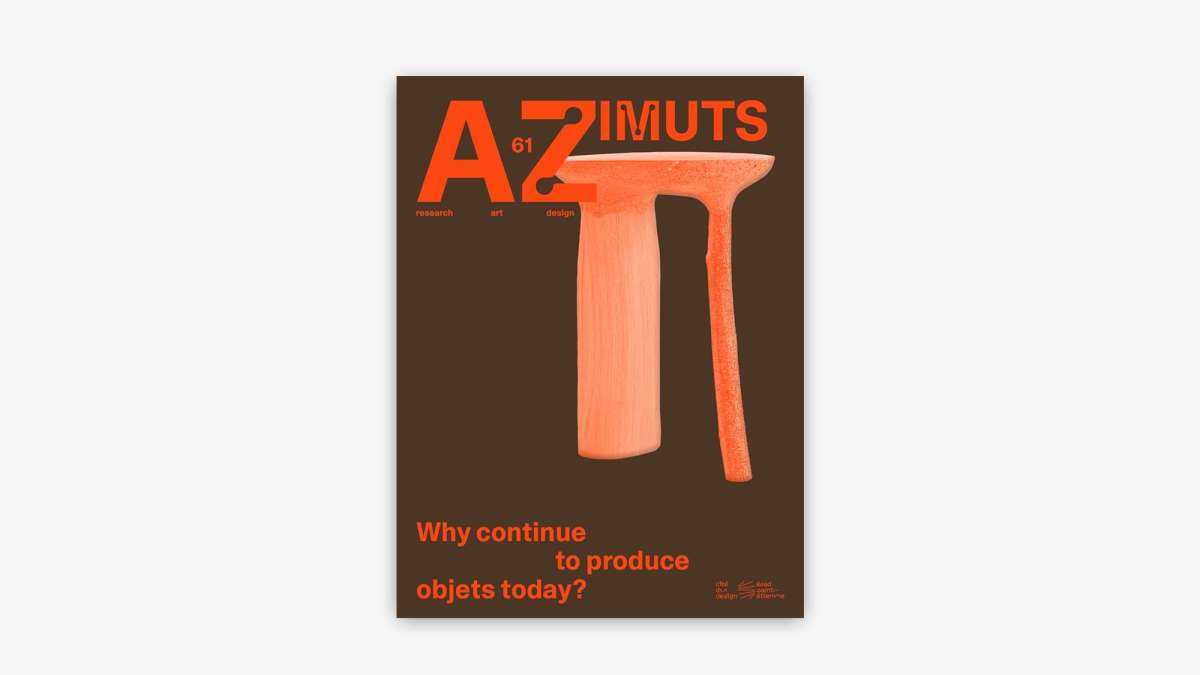
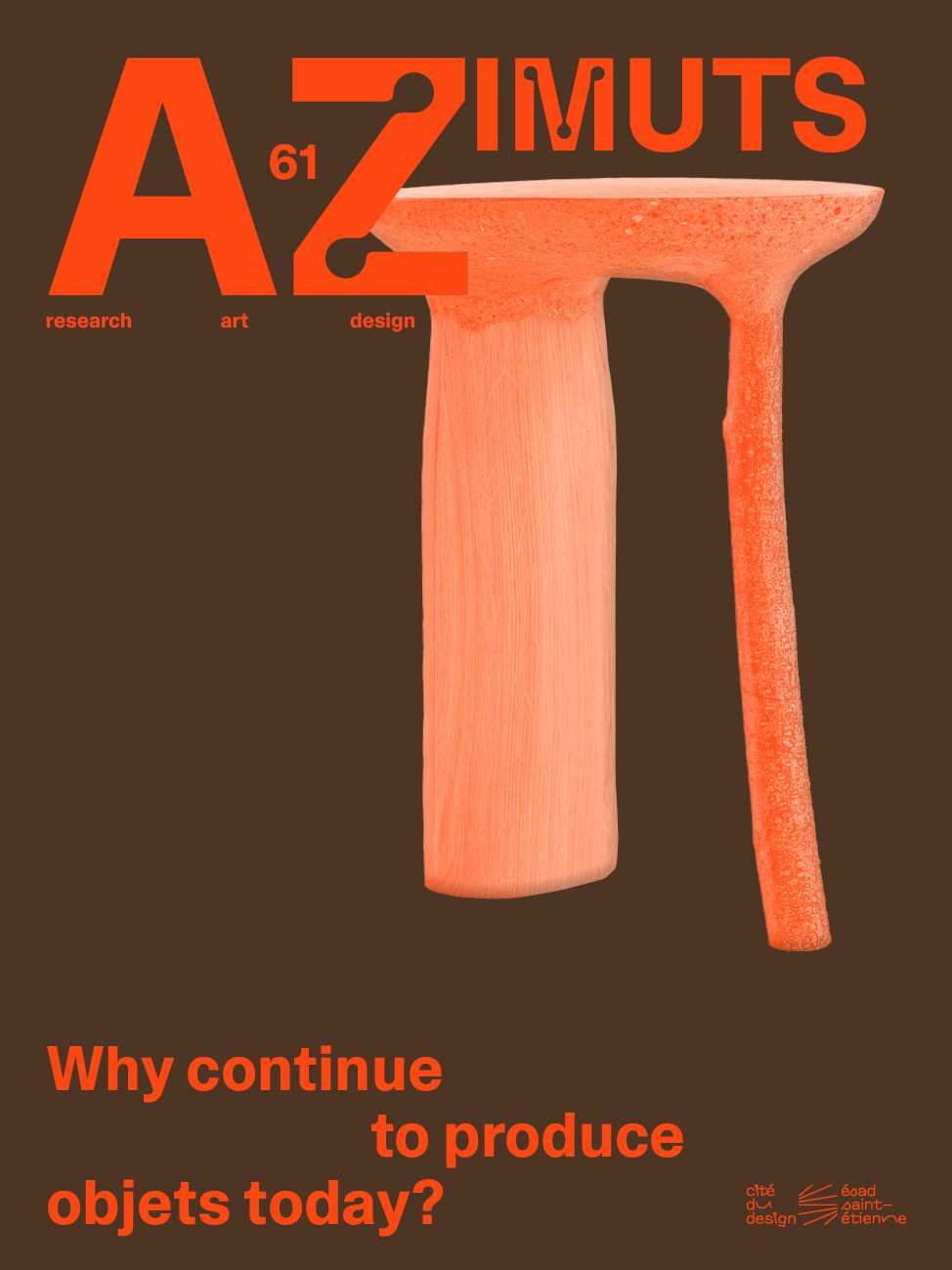
The Azimuts Research Art Design is dedicating its 61st issue to answering the question: Why continue to produce objects today ?
Why continue to produce objects today? In a world saturated with artifacts and facing ecological urgency, the very legitimacy of production seems to waver. Starting from this question, issue 61 of Azimuts brings together designers, researchers, artists, and students around contemporary object practices. The contributions gathered here explore different ways of designing today: producing differently, repairing, maintaining, transmitting, or sometimes choosing to produce less. The object appears in turn as a living archive, a trace of a territory, a mediator of relationships or a vessel for memory. Through these approaches, a vision of design attuned to environments, gestures, and resources takes shape—a design that questions what it still means to make.
Contents
p. 2 Labo Objet, editorial, Why continue to produce objects today?
p. 9 Gwenaëlle Bertrand, Producing to Transform, Knowledge, Practices, and Industries
p. 15 Rodolphe Dogniaux, Still Producing, Objects, Power, and Poetic Disobedience
p. 21 Coline Jeannelle, Creation and Procreation, What Possibilities for Designers?
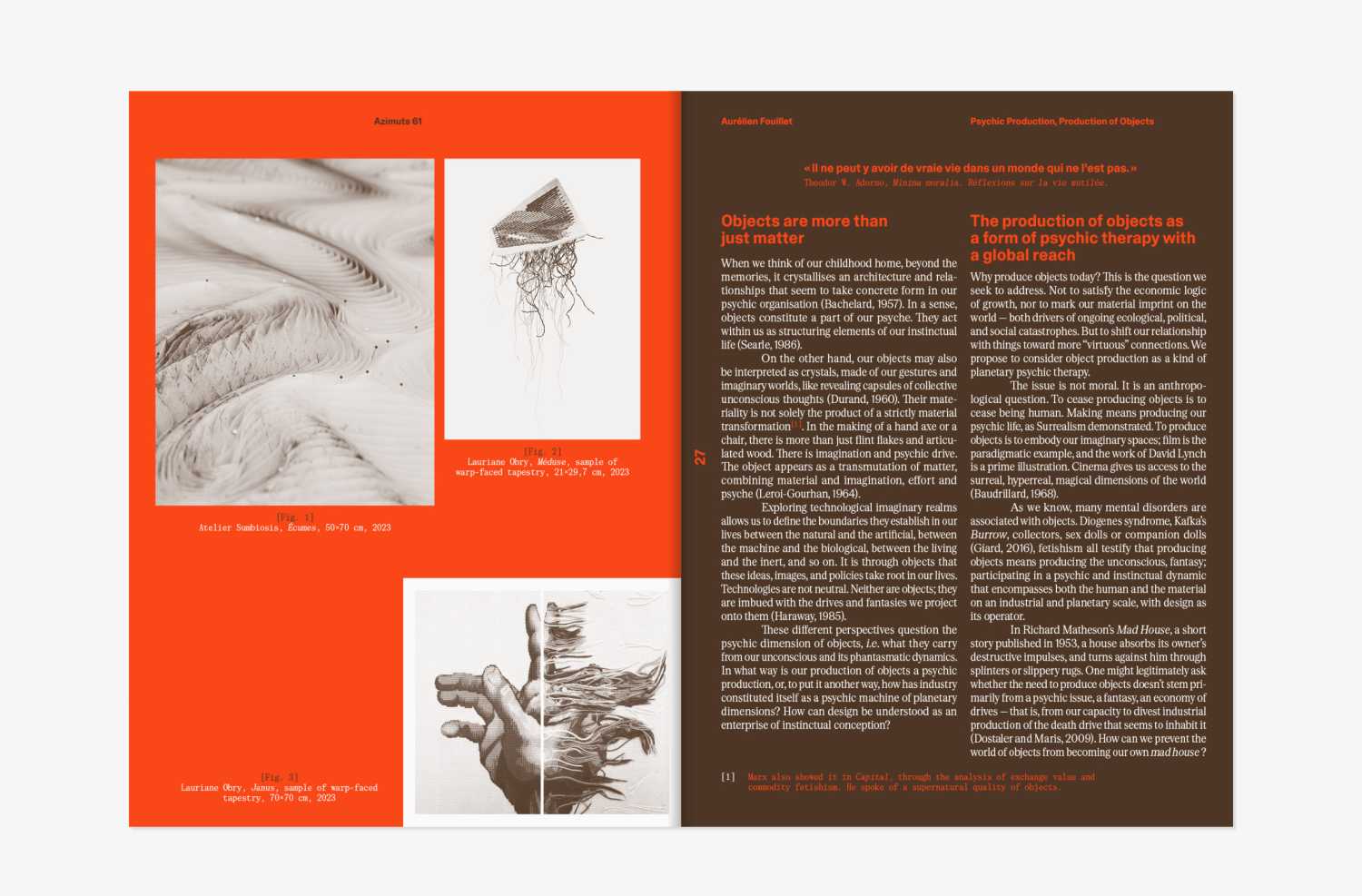
p. 25 Aurelien Fouillet, Psychic Production, Production of Objects,Design as a Psychoanalysis of our Presence in the World
p. 31 Lucas Carlot, Elliot Jeanneton–-Jochum, “What Do You Think of Object Design Today?”, A Dialogue between Lucas Carlot and Elliot Jeanneton–-Jochum
p. 35 Athime de Crecy, Martin Hoffmann, Arranging the World, Design and Forms of Life
p. 41 Thibaut Freychet, Bonbonnière
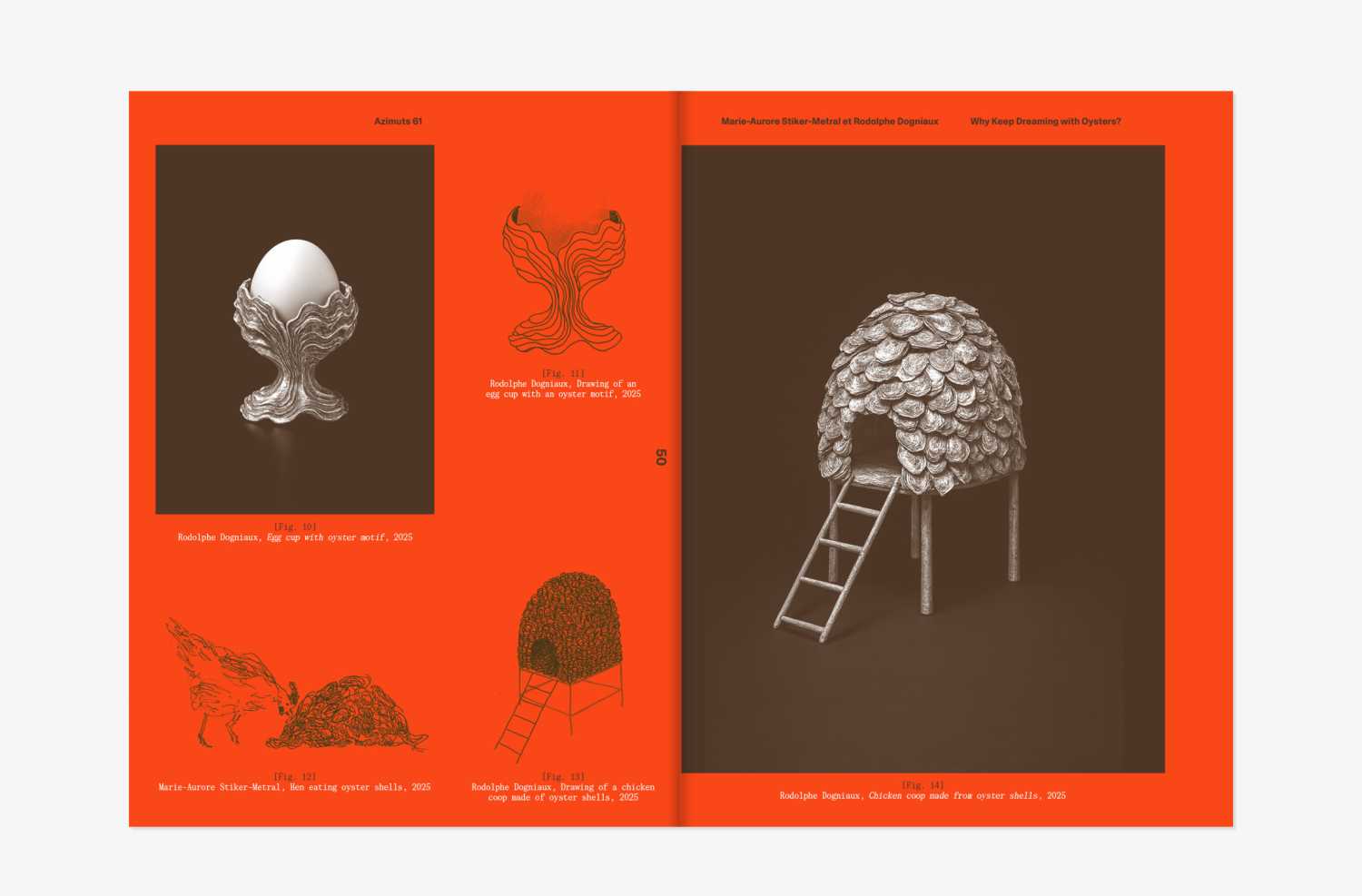
p. 45 Marie-Aurore Stiker-Metral, Rodolphe Dogniaux, Why Keep Dreaming with Oysters?
p. 53 “Objects, Crafts & Computation” Research programme in Art and Design, ECOLAB Research Unit, ESAD Orléans, DATA_vessel, Prospective cinerary urn
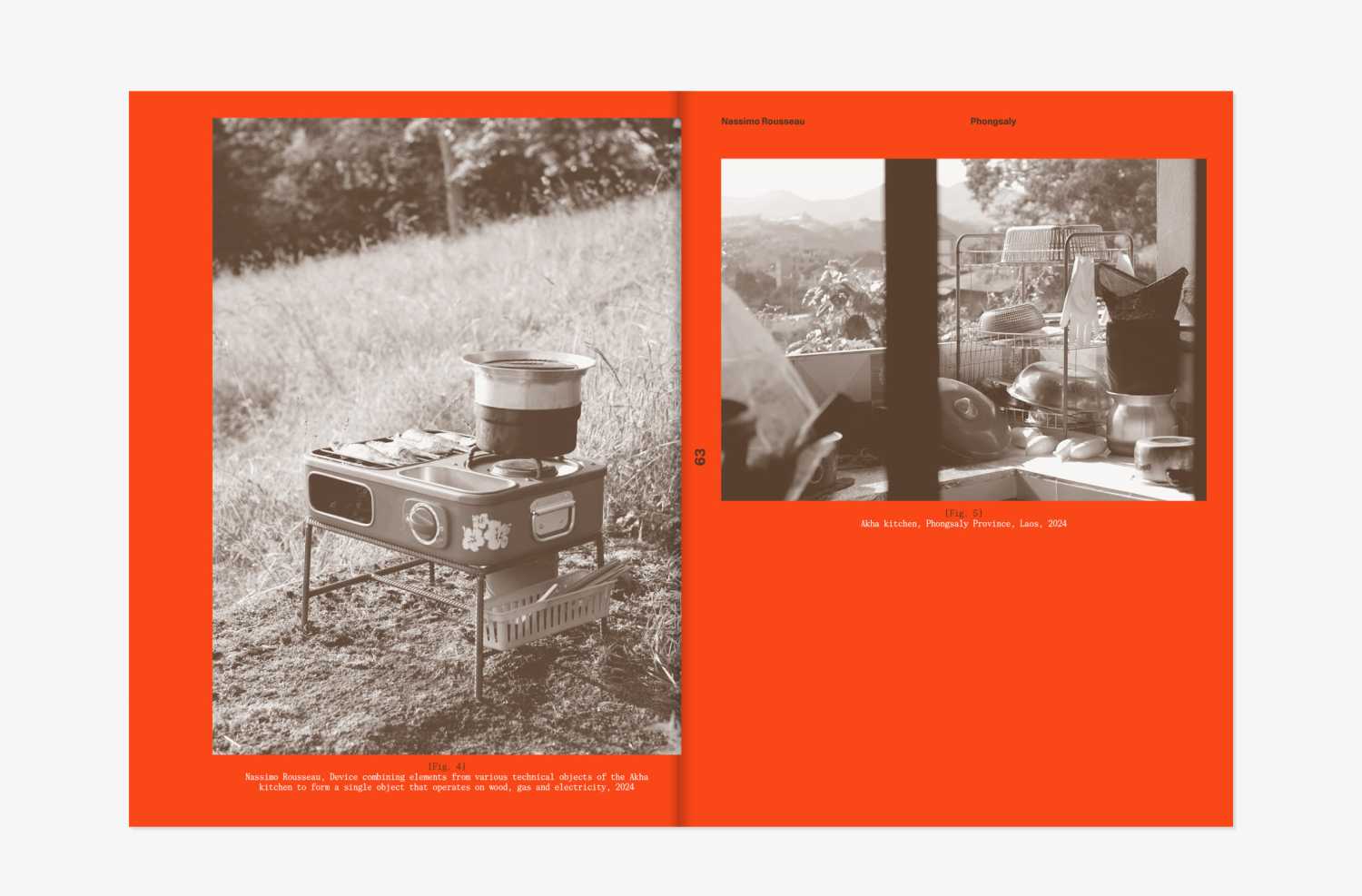
p. 59 Nassimo Rousseau, Phongsaly, Documentary Design
p. 69 Laurence Mauderli, Winter 1976: The Shakers in Paris, The exhibition Les Shakers : vie communautaire et design avant Marx et le Bauhaus (The Shakers: Community Life and Design before Marx and the Bauhaus) at the Centre de création industrielle (Centre for Industrial Creation), Centre Georges-Pompidou.
p. 83 Grégory Blain et Hervé Dixneuf (Atelier BL119), Shakers Workshop p. 85 Camille Bosqué, Form follows resources, Gathering, enhancing, harvesting, repurposing
p. 91 Camille Bosqué, From the construction site to the banquet, Our small workshop for excavated earth bowls
p. 97 Visual gallery
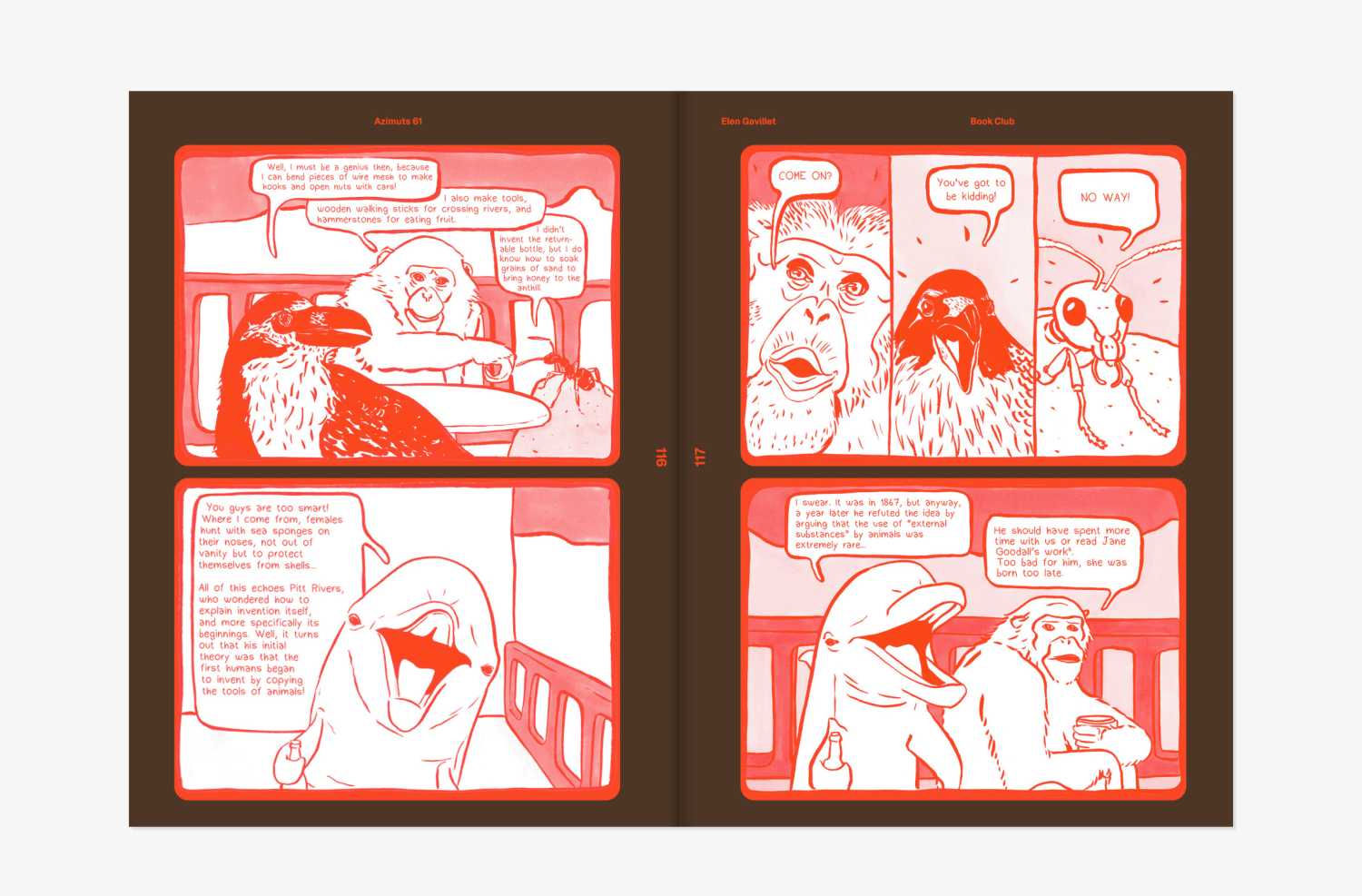
p. 113 Elen Gavillet, Book Club
p. 123 Emile De Visscher, Designing Dark Matter, Revealing and Transforming Production Ecologies
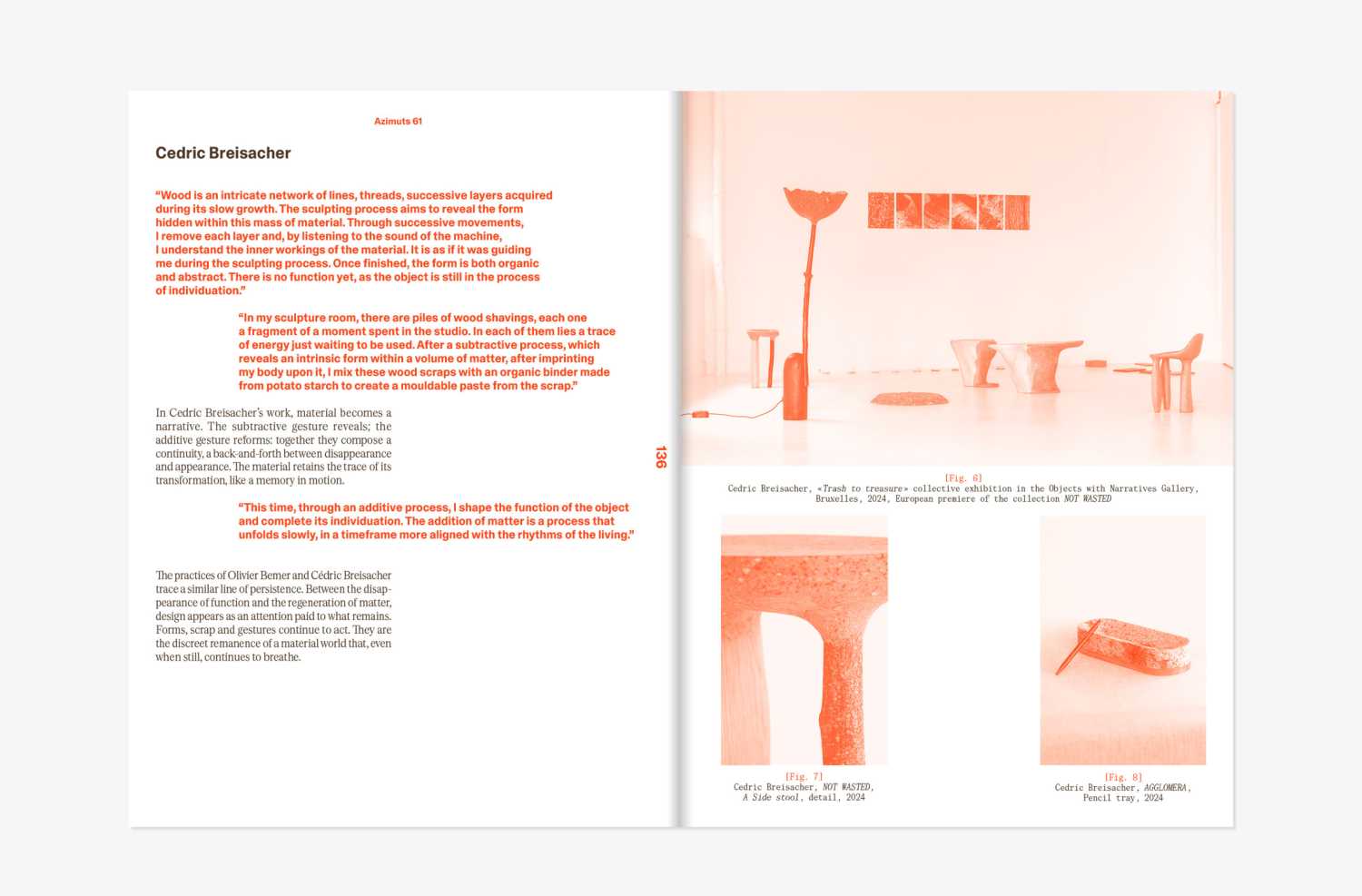
p. 131 Gregory Granados, Cedric Breisacher et Olivier Bemer, Remanences
p. 139 Marielle Granjard, Territory as a Design Material
p. 145 Goliath Dyèvre, Trajectoire
p. 149 Adelie Lacombe, Dorian Reunkrilerk, Anais Texier, Ecologies of Friction, Gestures for a Material Idleness in Public Design & Catalog of Findable Objects in Public Design
p. 158 Maxime Jambon-Michel, Sarah Not, Graphic notice
p. 160 Colophon & Acknowledgements
Editorial
Why continue to produce objects today?
The theme of Azimuts issue 61 was born within the Labo d’Objet (Object Lab), the research labora- tory of the École supérieure d’art et design de Saint-Étienne (Higher School of Art and Design). We are five designers, Elen Gavillet, Marie-Aurore Stiker-Metral, Grégory Granados, Ekatarina “Kiti” Brytkova and Rodolphe Dogniaux. Since our early days as students, a discreet yet persistent question has followed us: why continue to create objects?
Even today, this question permeates our project workshops. Our students ask it with curiosity, sometimes with scepticism, often with a sense of unease. This question, both personal and collective, seemed like a necessary starting point for this issue. Our aim is not to provide a definitive answer, but to open it up, to shift its focus, to circulate it through a plurality of voices, practices, and sensibilities.
In a world saturated with objects, confronted with climate urgency, resource depletion, pollution, and the weakening of ecosystems, the very legitimacy of production is faltering. The object, long the emblem of industrial progress, is now laden with ambivalence: desire and guilt, necessity and excess, attachment and rejection. How, in this context, can we continue to design without perpetuating the logic of depletion? What forms, what gestures, what values can still justify the act of production?
Rather than narrowing the discussion, we chose to broaden it. Designers, researchers, artists, and students were invited to share their commitments, practices, and doubts. The contributions gathered in this issue offer a thoughtful and open perspective on contemporary creation. The object appears in turn as a living archive, a trace of a territory, an extension of the body, a mediator of social relations, a repository of memory, and a space of resistance. It becomes a pretext for recounting our ways of inhabiting the world in a new light.
Some practices question the very source of the ges- ture: material, touch, wear, slowness. Others shift production towards attention, repair, main- tenance, transmission. Still others explore speculation, fiction, the symbolic, to bring forth other possible narratives of material culture. Here, the object is never solely an end in itself: it becomes a relationship, a process, a situation, sometimes even leading designers to give up on producing more.
Several texts explore the guilt associated with production, contrasting it with abundance, fertility, nurturing, and responsibility. Producing is no longer simply “making”, but also maintaining, repairing, supporting, and transmitting. The act of creation shifts from performance to attentiveness, from innovation to precision, from novelty to the transformation of uses and perspectives.
Through these approaches, another vision of design is emerging. A design atten- tive to environments, bodies, stories, local resources, invisible gestures, and material and social infrastructures. A design that accepts working with long timeframes, uncertainty, and the unfinished. A design that no longer seeks simply to add objects to the world, but to create spaces for relationship, repair, and storytelling.
This issue is also a space for graphic experi- mentation. We welcome two graphic designers, Maxime Jambon-Michel and Sarah Not, who contributed to its design, exploring layout as a space for research. Here, the editorial form engages in a dialogue with the content: it organises, guides, and suggests interpretations, just as the objects themselves order, transform, and embody ways of living.
Producing objects today is therefore no longer simply an act of manufacture. It is a sensitive, political, critical, and reflective gesture. To produce is to invent relationships, to prolong the memory of a place or a material, to support uses, and sometimes to accept producing less in order to process more effectively. It is to experiment with other ways of making the world. Through this issue, we are inviting the reader to come on board and participate in this open conversation, to explore the tensions, the doubts, but also the impulses that drive contemporary design practices. In short, this 61st issue of Azimuts is an invitation to persevere, despite the excess, the urgency, and the contradictions.
It reminds us that creating objects is never simply about manufac- turing: it is about reflecting, inventing, and bringing worlds into being. The question “Why produce more objects?” is not a passing doubt, but a critical driving force that engages the role of the designer, the place of objects in our lives, and the forms of creation that are both responsible and poetic. It is a call to design differently: consciously, with rigour, care, and sensitivity.
Gwenaëlle Bertrand is a designer and lecturer in Design at Jean Monnet University Saint-Étienne, where she is a member of the Études du Contemporain en Littératures, Langues, Arts (Studies of the contemporary in literature, languages and arts, ECLLA) research unit. Her research focuses on the relationship between design and industry (Voir dans les débuts du Tim Thom (1993-1996) une scène de recherche en design, Seeing in the beginnings of Tim Thom, a scene of design research, Sciences du Design, 2024), as well as on the influence of techniques in the design and production of artifacts (MàJ. Design, environnements techniques & pratiques exploratoires, Update: design, technical environments & exploratory practices, Cité du Design, 2021). She also develops interdisciplinary projects combining design and science, theory and practice (Générer par l’IA. Assimiler par le design, Generating through AI. Assimila- ting through design”, Azimuts, 2024). Concurrently, she is interested in teaching design processes through projects, where typification constitutes a major principle (L’approche par la typification dans les forma- tions en design, The typification approach in design training, JREA, 2024).
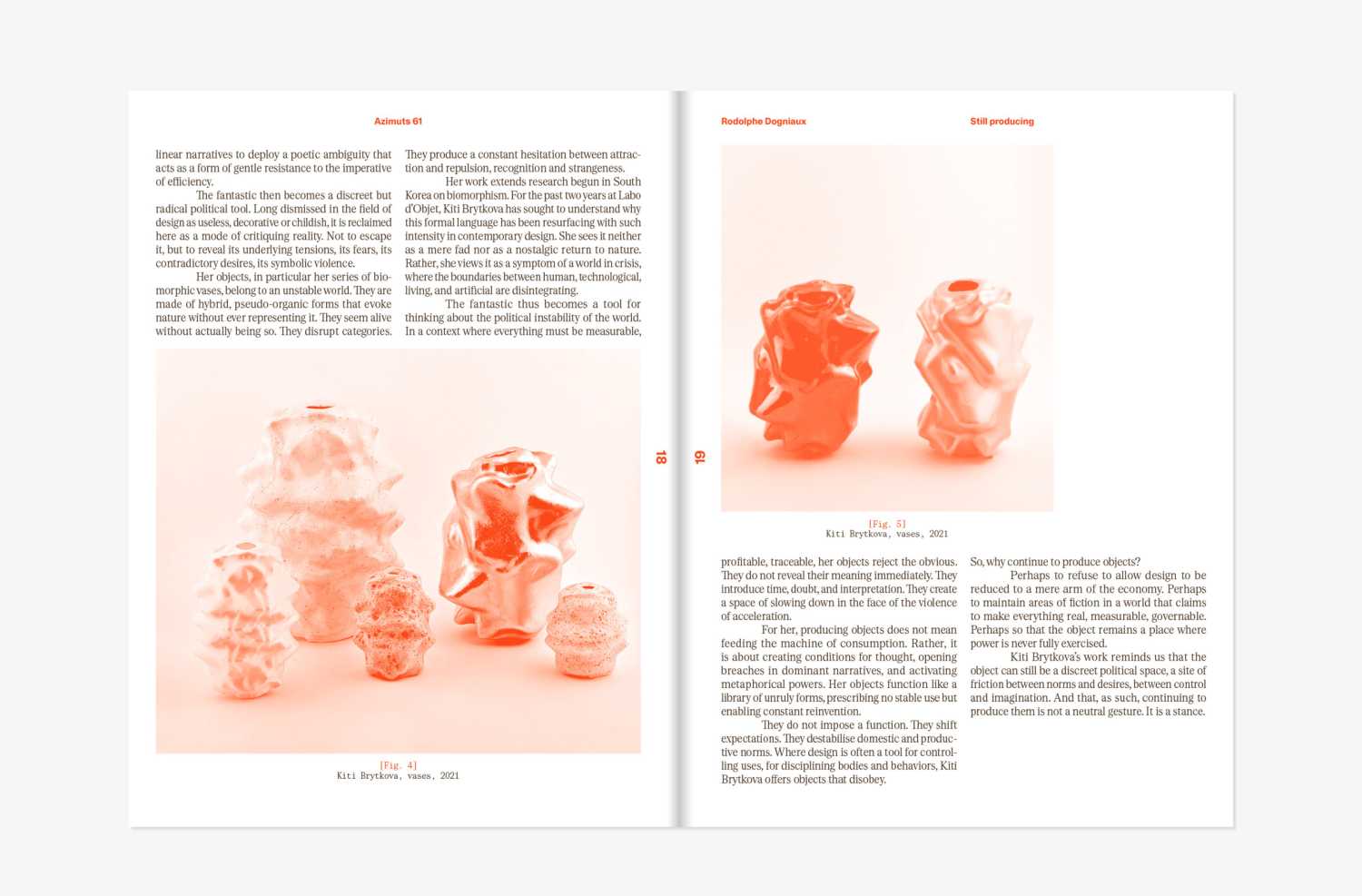
Kiti is a designer, researcher, and artist. She completed her post-master’s degree in 2025. Concurrently, she conducted research as part of a Céramique Comme Expérience (Ceramics as an experiment) residency at ENSA Limoges, whose results have been presented in several art galleries as well as at major events, such as the Saint-Étienne International Biennale, Dutch Design Week in Eindhoven, Milan Design Week, and the Faenza International Biennial of Contemporary Ceramic Art. A 2021 graduate of the École supérieure d’art et design de Saint-Étienne (Saint-Étienne Higher School of Art and Design) in Object Design, she was awarded the 2022 Design and Innovation Prize. This distinction enabled her to benefit from the support of the Surface Gallery, which hosted her first solo exhibition.
Rodolphe Dogniaux is a designer and teacher of Object Design in the DNSEP program at ESADSE, where he is a member of the Objet Lab (Object lab). He questions what it means to produce an object today, explores its forms, uses, and narratives, and advocates for attentive, critical, and responsible design. A graduate of ENSAAMA and ENSCI-Les Ateliers, he is also the founder of the Design Matin blog.
Initially trained in scenogra- phy, from live performance to museum exhibitions, Coline Jean- nelle is now studying product design at the École Supérieure d’Art et Design (Higher school of art and design) in Saint- Étienne. She is currently in her final year. Her research explores social themes such as care, power, education, and food. Her practice is both precise and playful. Her graduate thesis examines the symbolism of pasta and its connections to people and design.
Associate Professor and Research Supervisor at ENSCI-Les Ateliers, member of the CRD, and head of the MS in Contemporary Creation and Technology. Author of La vie des objets (The life of objects, published by Ateliers d’art de France in 2022) and Playtime (published by Les Pérégrines in 2022). My current research focuses on magical art and design, through the character of Jean-Eugène Robert-Houdin.
A fifth-year student at ESADSE, often seen in workwear, fuelled by coffee, and somehow always stylish, Lucas Carlot turned to design for its formal dimension, finding engineering lacking in sensitivity. He exhibits a certain indecisiveness when working, questioning each of his choices until he finds satisfaction. Interested in both artisanal and industrial prac- tices, he explores in his thesis how design and craftsmanship influence each other today.
Braving -5°C in Saint-Étienne, always wearing a t-shirt and never without his fanny pack, Elliot is a fifth-year student at Esadse. A wood shaving enthusiast since childhood, he turned to woodworking and sculpture, which he studied for 6 years. Between craftsmanship and design, Elliot explores how objects influence humans. His thesis focuses on the impact of rites of passage in societies, and explores new ways of introducing it.
Athime de Crecy is a Paris- based designer. He studied at the École Cantonale d’Art de Lausanne (Lausanne Cantonal Art School, ECAL) in Switzerland until 2017. He then joined UBIK and became one of Philippe Starck’s closest creative assistants. After five years working with the world’s most prestigious furniture and lighting companies on large- scale industrial projects while continuing to produce independently, Athime decided to dedicate himself fully to his own studio at the beginning of 2022 to focus on his design vision and the objects he creates.
graduate of the École Normale Supérieure de Lyon, Martin Hoffmann holds an Agrégation in Philosophy and is a PhD candidate at Sorbonne University (Paris 4). His research focuses on the philosophy of science, particularly the relationship between evolutionary biology and the Humanities. For years, he has cultivated a strong interest in the philosophy of technology and aesthetics, naturally leading him to examine the practice and challenges of design.
Trained in design at Jean Monnet University and the École supérieure d’Art et Design de Saint-Étienne (Saint-Étienne School of Art and Design), Thibaut Freychet develops a practice that connects partici- patory projects, ceramics, and territorial design. In 2022, he founded the pensez design stu- dio, dedicated to professionals in the gastronomy and tableware industries, where he explores ceramics and blown glass. As an author and curator, he questions the role of contemporary design. He lives between Saint-Étienne and the Ardèche region, pursuing research on the link between creation, ceramics, territory, and artisanal know-how.
Marie-Aurore Stiker-Metral is a designer, teacher, and member of the ESADSE Objet Lab (Object lab). She is a graduate of ENSCI-Les Ateliers and holds a Master’s Degree in Philosophy from the University of Paris X-Nanterre. Her practice is rooted in experimentation, materials, and manufacturing processes. Her interest in traditional skills and their enhancement in contemporary creations has materialised through numerous collaborations and residencies. Her work has been recognised with awards from the Académie des Beaux-Arts (Academy of Fine Arts) with the Pierre Cardin Prize, Audi Talents Awards, the City of Paris (Visa pour Osaka, Visa for Osaka), VIA (Valorisation de l’innovation dans l’ameublement, Valorisation of innovation in furniture), DRAC Auvergne Rhône-Alpes, DRAC Pays de la Loire, and the Hermès Foundation, among others. Marie-Aurore regularly designs projects for the French com- panies such as Ligne Roset and Cinna, based in the Ain region. She has collaborated with artisans in France, Japan, Vietnam, Mali, and Mexico.
The Research programme in Art and Design (PAD) “Objects, Crafts and Computation” (OCC) explores the interactions between artistic gestures, algorithmic form generation, and the physicalisation of data in the design of objects and artifacts. It articulates artisanal, even vernacular, know-how with digital practices. Methodologically, it implements collective processes that emphasise forms of cooperation, reciprocity, and solidarity. Caroline Zahnd (director), Sylvia Fredriksson, Olivier Bouton, Emmanuel Hugnot, (teacher-researchers), Etienne Mosnier, Amélie Samson, Eva Vedel, Batiste Wavrant, Luiz Gustavo Machado de Carvalho (Postgraduate students). With the contribution of Antoine Blouin, Léa Fernandes, Anne-Laure Fréant, Gabriel Martinez, Manon Souchet (Third cycle students) and 39 students in DNSEP Design specialising in “Design des communs” (Design of the commons) at ESAD Orléans.
Nassimo Rousseau is a designer, artist, and maker of everyday objects based in Paris. After growing up in Southeast Asia, he studied design at Ensci – Les Ateliers, where he developed a passion for manufacturing processes and photography. Attuned to the aesthetics of daily life, he explores how ordinary objects can reflect the social, cultural, aesthetic, and productive realities of their environments. Through research- creation projects that combine extensive fieldwork, repurposed semi-industrial manufacturing techniques, and documentary photography, he seeks to create new typologies of objects in response to a degrading globalised landscape. While the objects he designs sometimes evoke a sense of displacement, they also represent his attempt to craft a new reality—reconciling the asceticism of his industrial design training with his nostalgia for the rich, bustling interiors of Southeast Asia.
Laurence Mauderli is a design historian, author, exhibition curator, and lecturer in the history and theory of design (École supérieure d’art et design/ Cité du design, Saint-Étienne). She holds a doctorate in Art and Art History (University of Toulouse Jean Jaurès) and is a graduate of the Victoria & Albert Museum/Royal College of Art History of Design Postgraduate Programme. She co-curated the Design Collection at the Museum für Gestaltung in Zurich and has contributed to several design exhibitions (Victoria & Albert Museum, Centre Georges-Pompidou). She is the curator of the first exhibition of the new Galerie nationale du design (National Design Gallery), Saint-Étienne, which is entitled Design en main. Du langage à l’objet (Design in Hand. From Language to Object) and which will open its doors in June 2026. Her publications and projects focus on design and material culture, and their multiple historical and contempo- rary concepts and applications.
Camille Bosqué is a designer, holds a doctorate in Aesthetics and Design, and is a certified teacher of Applied Arts. She teaches Object Design at the École Boulle and at ENSCI - Les Ateliers (Paris). As a specialist in amateur practices related to the development of digital fabrication technologies and the proliferation of Fab Labs and other collaborative workshops, she published Open Design. Fabrication numérique et mouvement maker (Open Design. Digital Fabrication and the Maker Movement) with Éditions B42 in 2021. In 2024, she published Design pour un monde fini, Lexique à l’usage de celles et ceux qui veulent maintenir l’habitabilité du monde (Design for a finite world: a glossary for those who want to maintain the habitability of the world) with Premier Parallèle. This book addresses key questions for contemporary designers and presents an overview of essential issues for current and future generations of designers. Alongside her work as a teacher and researcher, she has been leading ceramics workshops since 2018 in various settings and with diverse audiences, exploring the properties and colours of excavated soil from construction sites in the Île-de-France region.
A Franco-Swiss designer, Elen Gavillet founded her studio in 2017. Today, she pursues her personal projects alongside teaching. She previously collaborated with designer Patrick Rampelotto and worked at the EOOS Design studio in Vienna, Austria, where she designed scenography, accessories, and furniture. In 2018, she was a finalist in the competition launched by Linkcity Sud-Est with her Olumine chandelier, installed in the headquarters of the Caf-Loire. The piece was crafted by the glassworks of Bréhat, with whom she still collaborates to this day. She won the Second Prize in the 2021 La Boule Art Déco competition at Émaux de Longwy for her Cosse vase, produced in a limited edition. Through her work and collaborations, Elen strives to contribute to the preservation of artisanal skills; with industrial manufac- turers, the designer plays with their technical capabilities to broaden the formal horizons of the objects she designs. Her research explores the place of the sacred in the domestic space. Elen observes the interstices where the spiritual resides: fragments of life and objects which, when assembled, create a coherent, sacred cosmos. She studies how we shape our own devotional objects to generate “individual memorial exhibitions”. Our interiors are becoming cabinets of curiosities where a sacred quality resides in objects whose meaning is known only to their owners. Elen designs temple-like objects to contain these personal relics, archives of memory, jujus, photos, or precious talismans. All these forms hold our secret beliefs, our hopes, an invisible world, answering the need to reconnect with ourselves by creating a coherent home.
Emile De Visscher is a lectu- rer-researcher, engineer, and designer. His 2018 Doctoral Thesis entitled Manufactures Technophaniques (Technophanic manufactures) explored the conditions for inventing technical processes that can be adopted by the widest possible audience. From 2019 to 2023, he was an associate member and led the Material Form Function research group at the Matters of Activity Cluster of Excellence at Humboldt University in Berlin. Since 2023, he has been a member of the Centre de Recherche en Design (Design Research Centre, CRD) team as a Junior Professor in Design pour les Transitions Écologiques (Design for Ecological Tran- sitions) at the École Normale Supérieure – Université Paris- Saclay. He is also an associate member of the SACRe laboratory (Université PSL / ENSAD).
hrough films, installations, objects and images, Olivier Bémer’s work explores our relationship to technical tools as a means of representation, and depicts a distorted reality where archetypes simulate but fail to truly represent. By using unconventional tools or through absurd staging, his installations playfully subvert form and function, and machine and learning. His work seeks to view technology as a symptom of our profound maladjustment to the world. In an environment increasingly streamlined by the digitisation of exchanges, paradoxes emerge here and there from a statistical ocean saturated with information. So much so that objects pre- process reality for us, making it more digestible, at the risk of robbing it of its flavour. Idleness is then abandoned in favour of better-marked paths — comfortable but well-trodden. Stereotypes wander awkwardly along these paths, and lacking a narrative to better articulate themselves, they fail to tell their stories. The future, therefore, struggles to materialise. Born in Paris in 1989, Olivier Bémer lives and works in Marseille. He is a graduate of ECAL, the Beaux-Arts de Paris, and Le Fresnoy – Studio national. His work has been featured in numerous group exhibitions, including the Emerige Foundation, the Fiminco Foundation, CWB Paris, the Pernod Ricard Foundation, and soon at the Chroniques Biennale in Aix-en-Provence, as well as in solo exhibitions, including at the Fonds de dotation Weiss in Paris and soon at the Centre d’art Fernand Léger in Port-de-Bouc. His work has also been shown at film festivals, notably the Annecy International Animation Film Festival.
Cedric Breisacher develops a narrative design rooted in materials. His practice questions the use of resources and recreates a sensitive connection between the object, the place, and the living. By integrating his own body into the object-making process, he creates a link between human beings and matter, where the tool becomes a mediator in the relationship between two beings. After attending ENSCI- Les Ateliers, he developed a research methodology focused on reusing waste to create new materiality, and transformed his workshop into a circular production unit. From his studio in Jardin des métiers d’Art et du Design (JAD) in Sèvres, he explores the notions of locality and circularity, using his wood shavings as a (re)source of materiality that allows him to reposition the object within its local context and history.
Born in 1991, Grégory Granados is a French designer based in Saint-Étienne. In addition to his training in cabinetmaking, lute-making, and carpentry, he earned his DNSEP from the École Supérieure d’Art et Design de Saint-Étienne in 2018. Since 2021, he has taught object design at the same school while continuing his own practice. The winner of the Grand Prix Design Parade Hyères in 2019, Granados develops his work around a salvage economy, focusing on discarded materials, overlooked objects, and pre-existing forms. His method, as he describes it, revolves around three actions—gathering, fragmenting, assembling—and explores the plastic, symbolic, and functional potential of collected fragments, which he reactivates through gesture and imagination. He selects, identifies, and merges while allowing the subject to take shape through the mani- pulation of matter, resulting in organic creations. Granados refers to this approach as an “opportunistic” stance: rather than creating ex nihilo, he composes with existing elements, granting them new uses.
Founder of the Matière Grise workshop in Ydes (Cantal), exhibition curator and consul- tant. Resident at the Villa Medici in Rome in 2000.Prix de la Jeune Création Métiers d’Art (Young Creation Prize in Arts and Crafts, Ateliers d’art de France) with a specialisation in Eco-design in 2003. Agrégée Professor and Doctor of Art Sciences, teacher at the Duperré School in Paris.
Goliath Dyèvre is a designer and a graduate of ENSCI-Les Ateliers, where he teaches today. For the past 10 years, his object design projects have been research- oriented, questioning the major issues of design on a historical, symbolic, and material level, as well as in terms of project methodology. He revisits the fundamentals of design, exploring themes such as the grasp of objects, morphogenesis, and industrial imagination. In 2015, he completed a residency at Villa Kujoyama in Kyoto, where he met artist Grégory Chatonsky, with whom he has since collaborated on the project The augmentation of things. Active in scenography and interior design within the fashion and luxury sector, he notably designed the window displays for Hermès boutiques in 2020 with the Planète blanche (White planet) project. He recently designed a concept store for the Japanese brand HIS.
Specialising in service design and public policy, Adélie Lacombe uses industrial design tools and collective intelli- gence to transform administra- tive and political processes, making them more accessible, inclusive, and efficient. A graduate in industrial design from ENSCI-Les Ateliers in 2017, she worked as a freelancer for public entities (Ademe, APHP, CMJC, FNAU, Ministry of the Armed Forces, etc.) and local authorities (Grenoble-Alpes Métropole, Dunkerque, etc.) before joining the Direction interministérielle de la trans- formation publique (Interminis- terial Directorate for Public Transformation, DITP), where she supports central government departments in designing and improving their public services and policies. She is currently a designer and teacher at ESAD in Saint-Étienne. Passionate about educational and mediation methods for complex thinking, she develops collective intelligence methods, supported by concrete tools, designed according to specific contexts.
naïs Texier works in public policy, collaborating with civil servants to understand the nuances of practices and to design solutions tailored to the real-world challenges faced by services. She designs investi- gative approaches, analyses pain points and needs, then struc- tures user journeys and content that facilitate access to public services and procedures. His work is characterised by a particular attention to clarity, evidence of use, and the quality of the relationship between administrations and citizens. By leveraging co-construc- tion, prototyping and active listening, she helps public organisations evolve towards more human-centred, useful and sustainable practices. Alongside her professional work, she teaches as a part-time lecturer in design and public innovation programmes, and documents the role of designers in public service with her podcast collective, DMC.
Dorian Reunkrilerk is an associate researcher with the Design, Arts, and Media research axis of Institut Acte, University of Paris I Panthéon-Sorbonne, and a member of the research team at Strate School of Design. His research explores how design contributes to shaping “ordinary” futures, rooted in situated materiali- ties. To this end, he focuses on how participation, both as a process and as an end in itself, can be embodied by design, drawing on design sciences (co-design, service design) and concepts from the humanities and social sciences (infrastructure, mediation, media). His work often engages with contexts where design practices are not pre-existing. This exploration has led him to work in an integrated manner within museum institutions, private organisations, and public administrations (such as the French Ministry of Education).
Labo d’Objet
This number is carried by the Labo d’Objet research team from the École supérieure d’art et design de Saint-Étienne. Labo d’Objet is developing an “Object-centered” research program which concerns the conditions of possibility, today, of object design. The team, observing that the object, representative of industrial creation and symbol of its contradictions, now finds itself caught in an aporia, engaged in a radical questioning of the object-to-come. It is part of the Unité de Recherche Design & Création de l’Esadse, supported by theMinistry of Culture.
Distributor and broadcaster: les presses du réel Publisher : Cité du design - Esadse Publication : April 2026 Language : English Format : digital pdf Pagination : 164 pages ISSN : 3077-3253· 61 ISBN : 9782492621376 Prix : 8€99